


Guest Blog: Meaning Does Not Have An Accent
- Scott Peddie

- Jun 18
- 4 min read
I am so grateful to Somayeh for her second guest blog on the topic of finding meaning through story-telling, writing, and listening. As a Certified Psychotherapist, Logotherapist-In-Training and published Novelist, she has a unique insight into this fascianting aspect of life; it is further enriched by her linguistic diversity - her native Farsi, fluency in English, and now learning German.
In this beautifully written article, Somayeh brings to life the creative reality and intricate process of finding meaning in this form of expression, and that ultimately, the transcendent nature of the noetic dimension is accessible to all.
'Meaning Does Not Have An Accent'
by Somayeh McKian
It is a realization that hits me slowly, but with absolute certainty, when I move my life across borders. The human spirit, what Dr. Viktor Frankl called the Noetic dimension, does not have a native tongue. Whether it speaks through the poetic warmth of Persian, the pragmatic clarity of English, or the intricate structures of German, its ultimate task remains unchanged: finding a way to trace the purpose that is already waiting to be articulated. And this waiting time is itself pregnant with inspiration and creation. Within this quiet space of transition, I have found myself falling in love with specific German words, even though I have noticed that German people rarely use them in everyday life. For me, discovering these hidden linguistic treasures is like finding rare artifacts in an excavation site. They serve as quiet signposts that guide me through the stillness of that waiting time, forcing me to confront deep, internal questions: What is my narrative now? How do I choose to narrate this new language, and how will it, in turn, rewrite me?
Many people warn you that German is a difficult, intimidating language. They complain about its rigid structure and endless rules. My experience has been exactly the opposite. I do not find German frustrating; to me, it is a meticulous archaeological site where details create meaning. In both literature and existential psychology, details are precisely the soil where the Logos is born.
Of course, there is an undeniably physical and temporal shift that occurs during linguistic migration. In Tehran, my words were sharp, fast, and deliberate—pregnant words. They won awards and filled pages. While learning German, my words are heavy, clumsy, and slow. For a novelist, this linguistic displacement feels like an existential stripping away. The velocity of my thoughts must adapt to a completely new rhythm.
But I realize this slowing down is not a limitation; it is an invitation to deep observation. In Logotherapy, Frankl emphasizes that meaning is never a vague, abstract concept. It is always highly specific—tethered to a concrete moment, a particular choice, a unique responsibility. When I sit in my intensive courses, I see that German grammar functions in the exact same way. The cases, the suffixes, the precise shifting of a verb to the very end of a sentence—these are tools of absolute precision. Every tiny grammatical detail changes the landscape of the thought.
Sitting in the classroom, I am reminded of Johann Wolfgang von Goethe’s belief in human potential, a belief that Viktor Frankl later used to show how the human spirit rises above its immediate limitations. Goethe famously wrote: “If you treat an individual as he is, he will remain how he is. But if you treat him as if he were what he ought to be and could be, he will become what he ought to be and could be.”
It is a beautiful historical symmetry that Frankl loved this quote and turned to it often. While he evoked the humanistic spirit of Goethe to mentally survive the camps in ...trotzdem Ja zum Leben sagen, he formalized Goethe's words into a literal clinical tool in Ärztliche Seelsorge to explain the stance of a therapist. To Frankl, we must look at a human being not just by their current restrictions, but by their latent potential for change and meaning. Holding my Kösel-Verlag German editions of his work here in Prague, I am realizing that while my German grammar is currently bound by rules, my Noetic dimension remains entirely free.
The Noetic dimension, the spiritual, uniquely human core of our being, is the seat of our deepest values, our conscience, and our "Will to Meaning." Learning German is not a process of displacing this spirit; it is a process of giving it a new, incredibly sharp set of instruments. Writing a story in Persian allows for a fluid, poetic, and multi-layered emotional canvas. Crafting thoughts in German forces a different kind of existential exercise. It requires you to know exactly who is acting, to whom, and with what intention, down to the very last syllable.
When I look at a complex German sentence structure, I am practicing the philosophy of both Goethe and Frankl. I do not look at the words merely as they are scattered on the page; I look at what they could be once they are properly declined and unified.
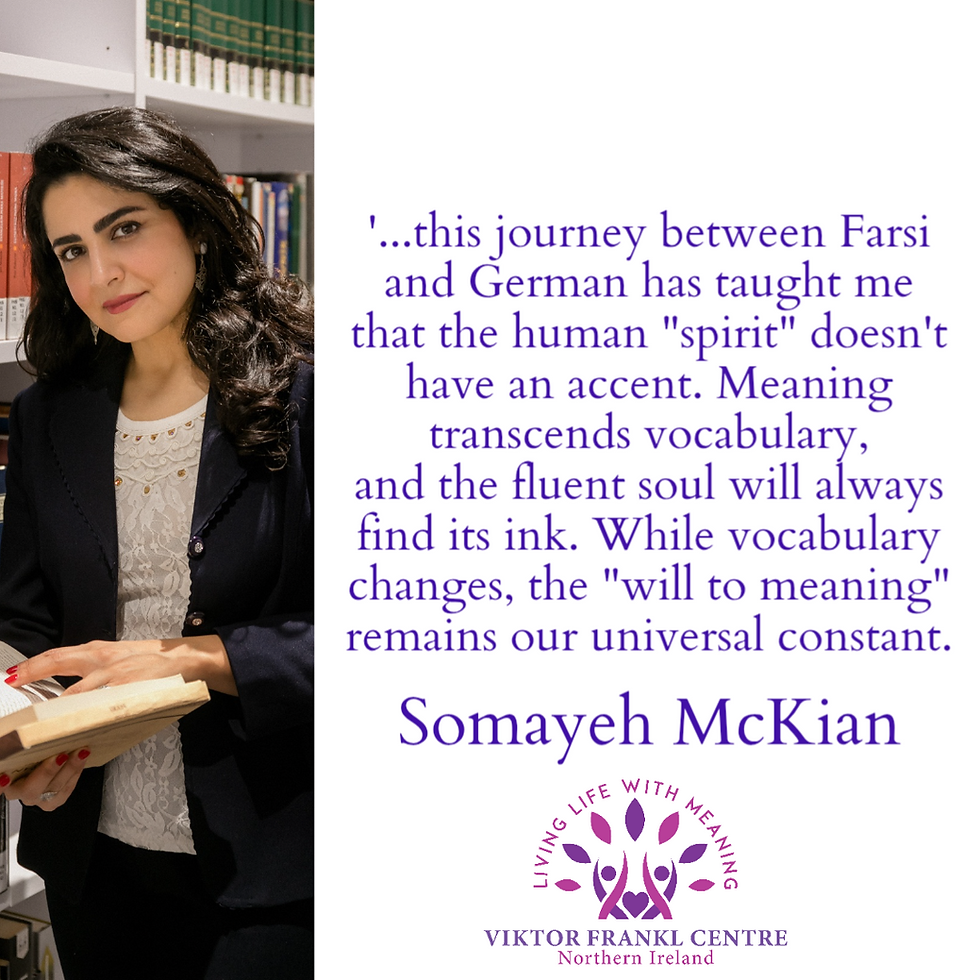
Ultimately, this journey between Farsi and German has taught me that the human "spirit" doesn't have an accent. Meaning transcends vocabulary, and the fluent soul will always find its ink. While vocabulary changes, the "will to meaning" remains our universal constant.



Comments