


Reflections From Iran: 'Life Has No Off Button'

Somayeh McKian
Certified Psychotherapist, In-Training Logotherapist, Gender Studies Scholar, & Published Author

Mostly, I encounter Logotherapy in places where I am not looking for it. Sometimes, it is not waiting inside a university, a consulting room, or a carefully constructed theory. I was walking through a street in Tehran when I noticed a small collection of second-hand books being sold by a middle-aged woman on the side of the street. Among the books was the Persian translation of Viktor Frankl’s Man’s Search for Meaning. I stopped and looked at it. The woman greeted me, and our brief exchange quickly became a conversation. I told her that the book she was selling was not simply a book I had encountered years ago; I was currently studying Logotherapy in another country. She immediately told me that she had read the book seventeen or eighteen years earlier.
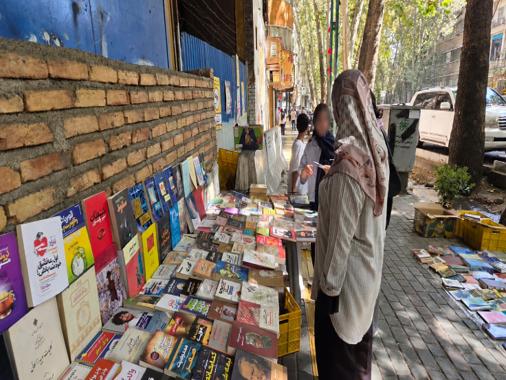


She remembered it as one of the books that had remained with her. She had recommended it to many other people since then because, in her understanding, it helped a person ask a fundamental question: what are we actually looking for, and how are we supposed to live? Then she began telling me her own story.
At some point in her life, she had developed a serious heart condition. Her doctors believed that she needed surgery on one of her heart valves. She asked her doctor how much time she had before the operation. The doctor told her one week. She responded that she would return after that week. What happened during those seven days became part of the way she understood her own recovery. When she returned, the results of her cardiac examination had improved considerably. The operation that had initially been anticipated was no longer performed in the same way; instead, the intervention was limited to repair.
She spoke about this experience with a remarkable conviction. She believed that she had to participate in her own recovery by preserving her spirit and refusing to surrender herself entirely to the illness.
I do not want to turn her story into a medical claim. Her experience cannot establish that attitude alone repaired her heart, and there are many physiological factors involved in any medical recovery. What interests me as a psychotherapist and a trainee logotherapist is something different: the way she understood what happened to her, and the meaning she gave to her own participation in life. She did not describe herself as a passive recipient of a medical event. She described herself as someone who still had something to do.
This distinction brought me back to one of the central questions of Logotherapy. Frankl's understanding of human freedom does not depend upon the fantasy that we can control everything that happens to us. On the contrary, existential freedom becomes particularly visible when circumstances cannot simply be removed. We may not be able to determine the condition into which we are placed, but we remain confronted with the question of how we will stand in relation to it.
The woman on the street corner seemed to have discovered this distinction through experience rather than theory. She then told me about another part of her story.
Following her heart procedure, she lost consciousness and remained in a coma for a period of time. During that state, she experienced a vivid dream or vision. Her mother, who had died many years earlier, appeared to her. Her mother asked her why she was lying there and told her to get up. The woman answered that she was exhausted. She had no strength and could not stand. Her mother took her hand.
In the strange logic of the dream, the woman suddenly became a two-year-old child. Her mother began breastfeeding her. As she was nourished, she gradually grew. She became larger and larger until she became herself again, the adult woman she had been. Then she walked. And she awoke.
She understood this experience as receiving life again. The image was, for her, something like a second birth: she had returned to the beginning, received nourishment from her mother, grown again, and emerged back into her own life.
I was struck by the architecture of the image. A woman facing the possibility of death returns, in her dream, not to an abstract heaven but to the beginning of life. She returns to the body of the mother, to nourishment, to infancy, to dependence, and then moves forward again into adulthood. The movement is not simply from weakness to strength. It is a return to the beginning from which continuation becomes possible.
Before language, before independence, before the adult self, there was the mother's hand and the nourishment that allowed the child to grow. Her dream did not present her with a philosophical proposition. It gave her an image through which she understood her return to life.
She then told me something else. People often commented on her spirit.
How do you have so much energy? How do you keep living like this?
She came from northern Iran, a region she associated with an almost stubborn vitality. She described herself through the landscape from which she came: a place of extraordinary greenery, where growth seems difficult to stop. There is something flowering in one season and something bearing fruit in another. Life changes its form, but it does not disappear. Then she said something that stayed with me:
Life has no off button.
For her, life did not simply switch off. There was always something still growing, something still emerging, something that could continue. Her understanding of life seemed inseparable from the landscape that had formed her imagination. I remember thinking that I had encountered something strangely familiar.
I had travelled from Tehran to another country to study Logotherapy. I had spent time reading Frankl and trying to understand how meaning can be discovered rather than imposed. And there she was, standing beside a pile of second-hand books in Tehran, telling me a story in which many of these existential questions had already become part of the texture of her life.
She did not use the language of existential psychotherapy. She did not speak about the Noetic dimension or the Will to Meaning. She simply told me what had happened to her and what she had made of it. This encounter made me think differently about what happens when a psychological theory crosses a cultural border.
Meaning Does Not Need to Be Imported
In my earlier reflections, I wrote about finding the ink to meaning: the idea that meaning is not necessarily something we manufacture but something we discover within the particular structure of our existence. Writing became, for me, a form of existential archaeology. I learned to look beneath the surface of a story for what its suffering, relationships, language, and choices might already be revealing.
The same question returned to me on that street in Tehran, but this time it was no longer about a fictional character.
What happens when we encounter a theory in a culture where the experiences it describes are already being lived?
Perhaps we should not always imagine theory as something that travels from one culture into another and gives people a new way of understanding themselves. Sometimes the experience comes first, and theory arrives later to give us a more precise vocabulary for questions human beings have already been living. This distinction is particularly important to me because I come from a culture in which questions of meaning have long been expressed through literature, poetry, spirituality, storytelling, family memory, and an intimate relationship with suffering. I do not mean that these traditions are identical to Logotherapy. They are not.
Nor would I claim that Logotherapy already existed in Iran in the precise historical or theoretical sense in which Frankl developed it.
But the existential question itself is older than the vocabulary.
The woman I met had her own vocabulary for the continuity of life. She did not formulate it as an existential proposition. She embodied it in the way she spoke about illness, recovery, death, her mother, and the landscape from which she came. For her, life continued. There was no final switch.
The Archaeology of Meaning
This encounter changed something in the way I think about my role as a psychotherapist, writer, and trainee logotherapist. If meaning can be discovered, then perhaps our task is not to bring meaning to people as if their lives were empty before we arrived. It is to listen closely enough to recognize the forms in which meaning has already appeared.
A person may never use the word meaning, yet the structure of their life may reveal a profound relationship with it. A woman may never speak about existential freedom, yet insist upon participating in her own life when illness threatens to reduce her to a diagnosis. Someone may never have studied Frankl, yet organize suffering around a question of responsibility, continuation, or hope.
And sometimes, as in this woman's story, the person has read Frankl but has not adopted his vocabulary as an academic language. The book has entered somewhere deeper: into the way she interprets what happens to her. This is where I see a connection with my understanding of writing. I am often not searching for an idea that I can place into a story. I am trying to recognize the idea that the story is already carrying. The same movement can occur in psychotherapy: listening not only for what a person says about a problem, but for the meaning that is taking shape through the way they tell it.
Perhaps cultural encounters require the same attention.
When we cross a linguistic or cultural border, we may be tempted to believe that we are carrying knowledge with us. But what we encounter on the other side may not be an absence waiting to be filled. It may be another expression of a question we already know, articulated through a different vocabulary.
In my previous reflection, I wrote that the human spirit does not have an accent. Learning German has made me increasingly aware that changing languages can alter the way we articulate experience without necessarily changing the deeper movement toward meaning that gives our experience its direction. That afternoon in Tehran gave this idea another dimension. Perhaps meaning itself also has no nationality.
Frankl gave us a sophisticated language for speaking about it. But the human search for meaning does not begin with Frankl. It begins with the human being who, in the midst of suffering, asks what to do with the life that remains.
The woman on the street corner had read Frankl many years earlier. Perhaps his words gave her a vocabulary for questions she was already carrying. Perhaps the book became one more piece of the narrative through which she understood her own life.
But when she told me her story, I was no longer simply listening to a reader of Frankl. I was listening to a woman who had transformed an encounter with a book into a personal philosophy of survival, responsibility, and continuation. And perhaps this is what I mean when I return to the image of ink.
The ink is not always something we bring. Sometimes it is already there.
It is hidden in the stories people tell about their illness, in the dreams they remember after coming close to death, in the landscapes they carry within themselves, in the books they recommend to strangers, and in the particular way they decide to continue living.
My joy is not to write meaning onto these lives. It is to learn how to recognize where the writing has already begun. That day, I stopped because I saw Frankl's book. But what I found was not simply Frankl. I found something waiting for me on a street corner in Tehran.
My passion is not to carry meaning from one country to another. Perhaps it is to become better at recognizing its many accents when I encounter it. And perhaps, once again, I had simply found the ink. It has no off button.

Comments