


Your Inner Hero: Exploring Jungian Archetypes

Some characters feel older than the stories they appear in. The brave traveller, the hidden monster, the wise guide, the mysterious beloved, these figures show up across myths, novels, films, dreams, and even daily life. Carl Jung believed that was no accident.
Jungian archetypes are recurring patterns of image, emotion, and behaviour that appear in the human mind. They are not fixed personalities, and they are not simple stereotypes. They are deep psychological forms that shape how people imagine themselves, face conflict, love others, and make meaning from experience.

What Jung meant by archetypes
Jung saw the mind as more than personal memories and individual habits. Beneath the personal unconscious, he proposed the collective unconscious, a layer of shared psychological patterns inherited through human experience.
Archetypes live in this deeper layer. They do not appear directly. Instead, they surface through symbols, dreams, myths, religious images, fairy tales, and stories. A dragon, a flood, a mother figure, a trickster, or a heroic quest may all express archetypal material.
Their significance in psychology lies in how they help explain recurring human themes:
the desire to become whole
the fear of what we hide from ourselves
the pull towards love, power, wisdom, or transformation
the need to create meaning during suffering or change
Jung did not treat archetypes as neat labels. He saw them as living forces in the psyche. When ignored, they may act through projection, obsession, or repeated patterns. When recognised, they can support self-knowledge and growth.
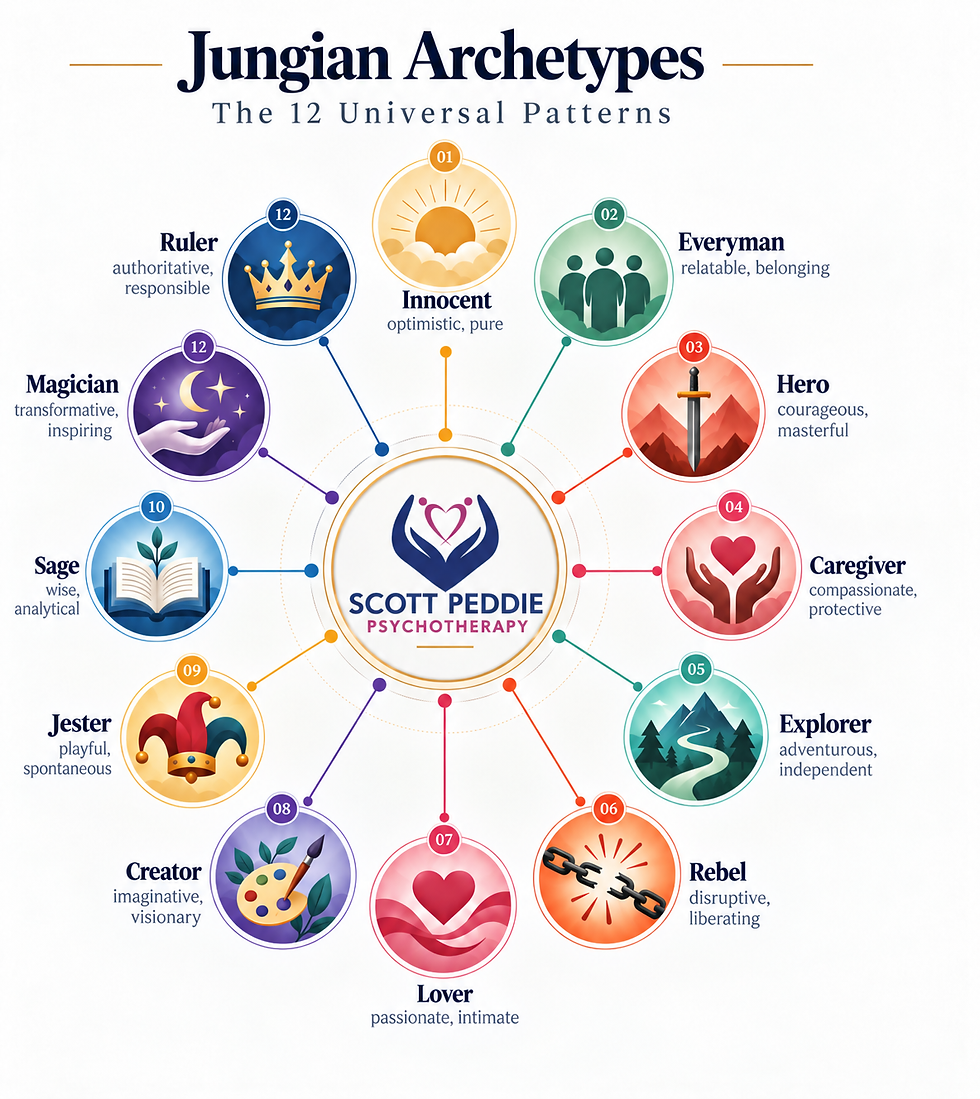
The Hero shows the struggle to become oneself
The Hero is one of the easiest archetypes to recognise. This figure leaves familiar ground, faces danger, gains knowledge, and returns changed. The Hero’s journey may involve monsters, mentors, temptations, and sacrifice, but psychologically it points to one central movement: leaving unconscious dependence and moving towards a stronger sense of self.
In literature, Frodo in The Lord of the Rings carries the ring across Middle-earth, but the deeper struggle is inward. The ring tests his fear, loyalty, endurance, and desire for power. In film, Luke Skywalker in Star Wars begins as restless and unformed. His path forces him to face loss, discipline, temptation, and his own family shadow.
The Hero archetype matters because it gives shape to personal development. It appears whenever someone must:
leave an old identity behind
take responsibility under pressure
face fear rather than avoid it
return with a new understanding of life
The danger is inflation. A person under the spell of the Hero may start to believe every conflict proves their special destiny. Healthy heroism includes courage, but also humility.

The Shadow reveals what the ego rejects
The Shadow contains the traits, desires, fears, and impulses that a person refuses to identify with. It is not simply “evil”. It may hold aggression, envy, shame, sexuality, grief, ambition, weakness, or even creativity and vitality that were pushed away.
The Shadow often appears in stories as a monster, double, villain, or dark mirror. In Dr Jekyll and Mr Hyde, Robert Louis Stevenson gives the Shadow a literal body. Hyde represents what Jekyll cannot admit about himself. In The Dark Knight, the Joker works as a chaotic Shadow figure to Batman’s controlled moral order.
The Shadow influences relationships through projection. Someone may strongly condemn a trait in another person because they cannot bear to see a related impulse in themselves. For example, a person who denies their own anger may become obsessed with how “aggressive” everyone else seems.
Shadow work, in a Jungian sense, does not mean acting out every impulse. It means becoming honest about inner material so it can be understood and integrated. Acknowledging anger can become boundary-setting. Admitting envy can reveal desire. Facing fear can reduce its control.
The Shadow becomes most dangerous when it remains completely unconscious.
The Anima and Animus shape inner relationship patterns
The Anima and Animus are among Jung’s most debated archetypes. In Jung’s original language, the Anima referred to the inner feminine image in a man, while the Animus referred to the inner masculine image in a woman. Many contemporary readers approach these ideas less rigidly. Rather than treating them as fixed gender rules, they can be understood as inner images of the “other” within the psyche.
These archetypes influence attraction, imagination, creativity, and emotional life. They often appear in dreams and stories as a mysterious guide, lover, muse, stranger, or challenging figure.
In Jane Eyre, the relationship between Jane and Rochester carries archetypal force because both characters must confront hidden parts of themselves before love can mature. In Studio Ghibli’s Spirited Away, Chihiro’s encounters with figures such as Haku help her move through fear, memory, trust, and identity.
When Anima or Animus material is projected onto another person, romance can become idealised. The beloved may seem magical, perfect, dangerous, or destined. Over time, real relationship asks for the projection to soften so the actual person can be seen.

Why archetypes matter in stories and self-discovery
Archetypes give stories emotional depth because they connect plot to inner life. A dragon is rarely only a dragon. It may represent fear, greed, chaos, trauma, or the unknown. A descent into a cave may suggest a meeting with the unconscious. A return home may signal integration.
That is why archetypal stories remain powerful across cultures and eras. Shakespeare’s Hamlet explores the divided self, the ghostly demand of the past, and the paralysis that comes from inner conflict. The Lion King uses the Hero, the Shadow, the Wise Old Figure, and the return to rightful responsibility in a form that feels simple but resonates deeply.
In personal development, archetypes offer a language for patterns that can otherwise feel vague. Someone might ask:
Where am I being called to act with courage?
What am I refusing to see in myself?
What qualities am I projecting onto others?
Which story about myself am I repeating?
These questions do not replace therapy or careful psychological support, especially when distress is serious. But they can open a useful path of reflection.

Finally...
Jungian archetypes endure because they speak to both imagination and experience. The Hero shows the courage to change. The Shadow asks for honesty. The Anima and Animus reveal the inner figures that shape desire, creativity, and connection.
To read stories through archetypes is to see why certain characters stay with us. To read life through them is to notice the patterns asking to be understood. The value is not in labelling every person or plot, but in becoming more conscious of the forces that shape a life from within.

NOTE: Contains some AI material.
Comments