


Online Logotherapy Diploma Course: Accepting Applications!

The Viktor Frankl Centre NI
Diploma in Logotherapy & Existential Analysis
The Diploma in Logotherapy and Existential Analysis is an advanced programme for existing Therapists/Counsellors, Psychiatrists, Psychologists, Social Workers, and others with relevant expertise and professional standing.

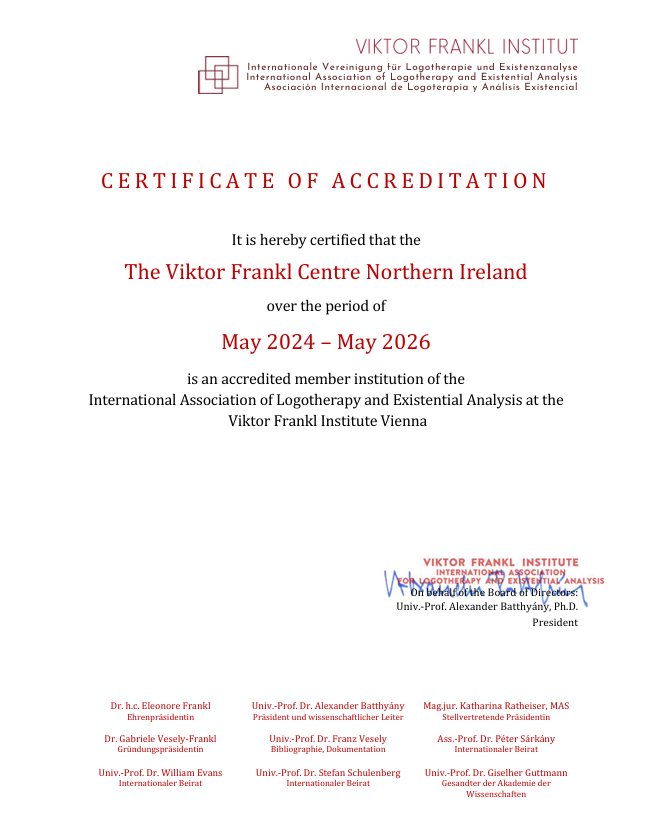
The course is fully Accredited by the International Society of Logotherapy and Existential Analysis at the Viktor Frankl Institute Vienna. Following successful completion of the course, graduates will be awarded the Diploma in Logotherapy and Existential Analysis. They will also be recognised as individually Accredited Logotherapists by the Viktor Frankl Institute Vienna, following payment of a registration fee (renewable every two years), and are then able to offer professional services as Logotherapists.
The Viktor Frankl Centre is one of the newest accredited training institutes across 45 countries. It is the first, and currently only organisation of its kind in Northern Ireland, and only the second on the Island of Ireland.
What is Logotherapy?
Logotherapy and Existential Analysis is a talking therapy developed by the Viennese Psychiatrist, Neurologist, Philosopher and Holocaust Survivor, Prof. Viktor Frankl.
The key element in Logotherapy is an acknowledgement that we can find meaning in unavoidable suffering. By tapping into that sense of meaning, we are enabled to see new, and more satisfying ways of living a life that is authentic and purposeful.
As Frankl himself wrote in his Autobiography: “When we are no longer able to change a situation, we are challenged to change ourselves.” Logotherapy helps us to do just that.
Logotherapy also functions on Frankl’s premise that: “Everything can be taken from a person but one thing: the last of the human freedoms—to choose one’s attitude in any given set of circumstances, to choose one’s own way.” Again, Logotherapy provides us with the tools to facilitate change in how we view life’s challenges, and it does so in a way that is focused, empowering and re-humanising.
Logotherapy has a broad applicability across a range of diagnoses, including depression, anxiety, addiction, and trauma. It can be used as a stand-alone therapy, or in conjunction with other therapies. It is also used as a means of navigating stressors in everyday life, including grief, chronic illness, relationship issues, career choices, and end of life situations.
The Diploma
Entrance Criteria
Candidates are recommended to be qualified, registered and insured with the appropriate professional bodies in the fields of nursing, psychiatry, counselling, midwifery, social work and psychotherapy. We will also accept clergy with a suitable background in pastoral care, health-care chaplaincy and/or spiritual direction. Other candidates who fall outwith these groupings, including business and personal coaches, and who are deemed to be sufficiently experienced, will be considered on a case-by-case basis.
To register an interest, contact the Centre Director, and Founder, Dr. Scott Peddie, via email at: scottpeddie@sky.com.
Teaching Format and Delivery
Core Teaching will consist of lectures, seminars and practicums, with reflective practice (applied Logotherapy) and self-care (utilising Logotherapy for the therapist) as an integral part of the programme. Teaching is currently exclusively provided by remote learning via Zoom or MSTeams.
There are 4 contiguous semesters in total, with students expected to attend classes as follows:
2 x 6hr sessions at the beginning of each semester.
1 x 6hr session per month (scheduled for Saturdays) during each semester.
The course will be completed in 18 months.
There will be a total of 120 hours of learning (72 hrs face-to-face; 48 hrs self-directed Learning), which will consist of interactive lectures, case studies, practicums and reflective practice. Students will be expected to explore meaningfully how they will integrate what they have learned into their current therapeutic practice, as well as being able to apply Logotherapy as a standalone therapy, safely and effectively.
Our ethos is summed up in the words of John Dewey: ‘we do not learn from experience….we learn from reflecting on experience’.
Students are expected to attend at least 80% of classes, with discretion for those who have legitimate reasons for not reaching this figure. In any case, students are required to complete a 750 word reflective piece at the end of each semester; this will be read by the tutor, and discussed with the student, but will not be graded. The aim is to enhance clinical skills via meaningful reflective practice.
Curriculum:
The modules (one per semester) are as follows:
General Philosophical Perspectives on Mental Health:
Understanding Ontology, Phenomenology, and Nosology as the Philosophical Basis of Psychotherapy.
Comparison of Psychotherapeutic Methods (Psychodynamic/Psychoanalytic, Humanistic, Cognitive-Behavioural etc).
Frankl’s Philosophy of the Person (contra Freud and Jung) as the Basis of Logotherapy & Existential Analysis.
Applied Philosophical Perspectives on Logotherapy and Mental Health:
Freud, Adler and Frankl: Will to Pleasure; Will to Power; Will to Meaning.
Part 1: Will-to-Meaning, Defiant Power of the Human Spirit, Suffering and Tragic Optimism, Consciousness, Existential Vacuum and the Tragic/Neurotic/Triumphant Triad.
Part 2: Self-Transcendence and the Realisation of Values (Experiential, Creative, Attitudinal).
Philosophical Influences: Heidegger and the Stoics.
Clinical Application of Logotherapy and Existential Analysis:
Frankl’s Theory and Therapy of Mental Disorders.
DSM and ICD in the Context of Logotherapy.
Logotherapy as a Transdiagnostic Therapy.
Logotherapeutic Techniques: De-Reflection, Socratic Dialogue, and Paradoxical Intention as Meaning-Centred Applications.
Autogenic Training.
Medical Ministry
Extensive Case-Studies
Advanced Clinical Application of Logotherapy and Existential Analysis:
Scientific/Evidential Basis for Meaning-Based Psychotherapies.
Case Formulation.
Use in Treating and Facilitating Recovery in Addictions, Bipolar Disorder, Trauma and Psychosis.
As a Stand-Alone Therapy.
As a Co-Therapy with Particular Emphasis on EMDR and Trauma.
As a Means of Building Resilience.
Extensive Case Studies.
Calendar
The course is designed to be flexible in order to meet the needs of the participants. For that reason, we are only providing a start date for the first semester at this stage – 26th September 2026 - the rest will be scheduled by agreement with the group.
Personal Therapy
There will also be a requirement for students to engage in a minimum of 10 personal therapy sessions over the duration of the course; these will be facilitated primarily by Dr. Peddie, but also by other Accredited and suitably experienced Logotherapists working internationally; it is likely that most of the therapy will be delivered remotely. This provides an excellent opportunity for self-exploration and understanding in an Existential framework.
Supervision
Given the Clinical focus of the Diploma, 10 hrs of supervision, free of charge, is offered for each student across the course of study; this will augment the theoretical underpinning of the Diploma course, whilst also supporting Logotherapists in training. Supervision is key to ensure students remain grounded, maintain ethical boundaries, develop their skills, and focus on effective self-care.
Teaching/Training Faculty
Dr. Scott Peddie
BSc., MSc., MDiv., PGCert., PhD., GradCertTh., Diploma in Logotherapy & Existential Analysis., Advanced Diploma In Jungian Psychology., Diploma in Jungian Theory & Practice., Diploma in Jungian Psychology., Diploma in Jungian Dream Analysis., FISPC., FRSPH., FRSA.
Scott is an experienced Logotherapist & Existential Analyst working in private practice, an Honorary Lecturer in Mental Health (School of Nursing, Faculty of Medicine, Health and Life Sciences at Queen’s University of Belfast), and the Founder/Director of the centre.
He has previously held posts including Managing Director and Co-Founder of an International Consultancy Company (with clients in Venezuela, The Netherlands, Belgium, Australia, Norway, and Canada), Directorships of four Charities with an international remit, and two commercial organisations. He has also held senior posts in Industry and Academia, including Editorial Director, Chief Examiner, R&D Manager, and Learning and Service Innovation Manager.
He has/has had clients from 33 countries including Iceland, New Zealand, the USA, Saudi Arabia, Malaysia, Norway, Thailand, Germany, Luxembourg, Oman, Australia, Croatia, and Italy.
Scott has written and is currently delivering the Diploma in Logotherapy & Existential Analysis Supervision - the first course of its kind - to colleagues in Ukraine.
Honorary Lecturers/Adjunct Faculty, who are experts in their field, are part of the teaching team at various points throughout the course; their expertise augments the student experience and to widens the scope of the core teaching.
Our current Honorary Lecturers are: Paul Brennan (Ireland), Somayeh McKian (Germany/Iran), Colin Hughes (UK/Ireland), and Chantal Ishac (UAE).
Cost
Each module costs £750 (Total £3,000), plus personal therapy, which will be charged at a reduced rate of £50 per session (Total £500), that is an overall cost of £3,500. Payment plans are available to spread the cost of both tuition and therapy. It is recommended that each student considers further personal therapy beyond the basic requirements, again at the discounted rate, but this is entirely optional.
How do I Apply?
Applications for the September 2026 intake open on 10th March 2026 and will close on 1st July 2026. Each application should contain the following information and should be e-mailed to the Director of the Viktor Frankl Centre prior to the closing date via scottpeddie@sky.com.
Applicants are required to submit a short (two-page maximum) CV/Resume detailing relevant experience.
A 1,000 word reflection on how the applicant sees Logotherapy impacting on their current practice and how it will potentially benefit them both professionally and personally. There is an option to have a further discussion with the Director to explore how you will benefit from the course – this is supportive and non-formal in nature.
If relevant, proof of Professional Accreditation/Indemnity Insurance. Copies of relevant Qualifications (Academic and Professional/Vocational) are also required.
Any Questions?
Please do contact the Director should you have any queries in relation to the Diploma course!
Comments